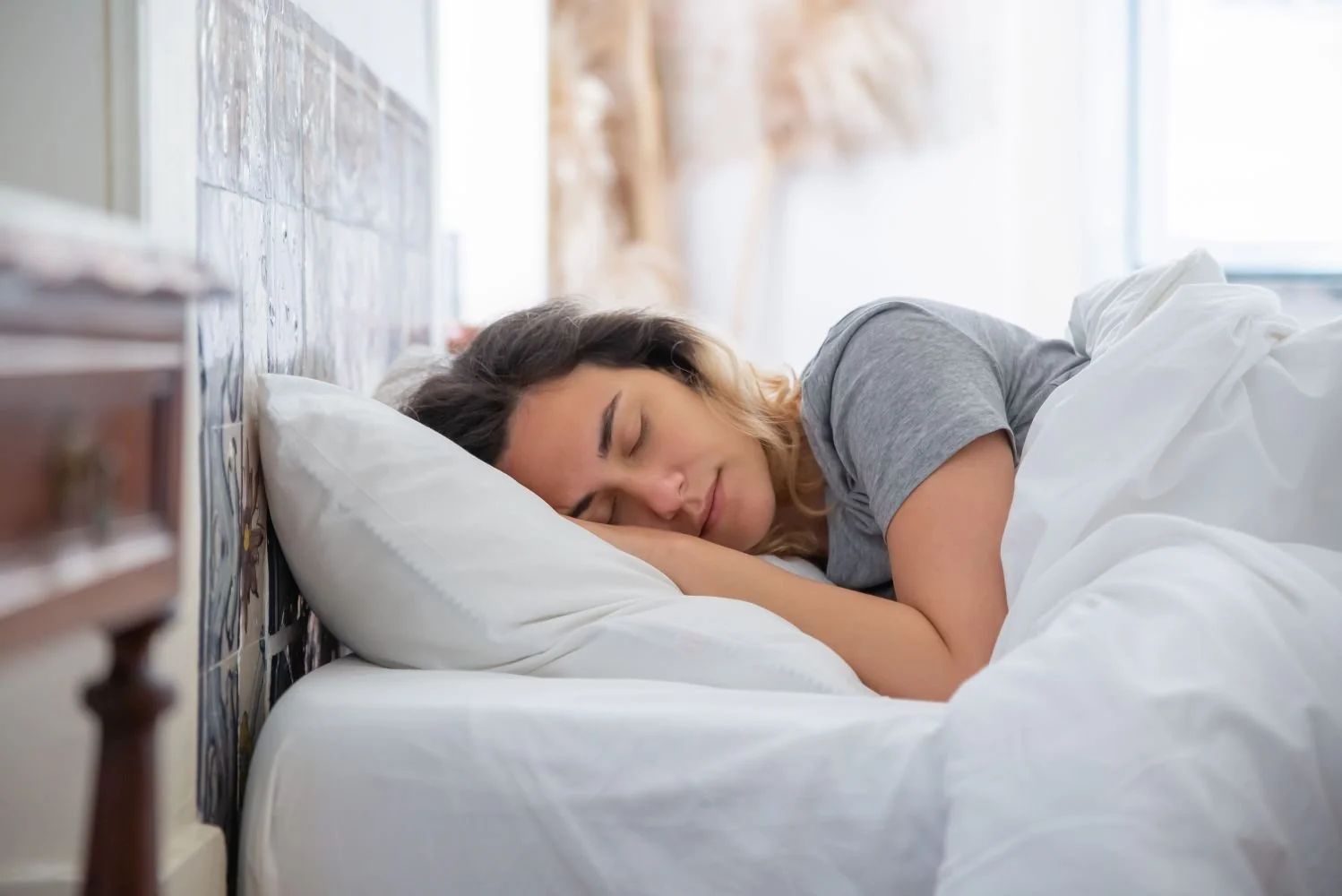
You wake at 2 am because the mattress has shifted. Your wife’s side of the bed is empty, the duvet dragged off. You find her sitting on the stairs in a t-shirt with the landing window wide open. This isn't the first time. It's been going on for months, maybe longer, and you've already tried the obvious things. A cooling fan, eating earlier in the evening, cutting down on the wine and nothing is working. Now you’re at a crossroads and she is starting to shut you out. After all, you’ve tried everything already and talking only seems to make things worse. Frankly, your dear wife, partner, significant other, would rather you stopped mentioning the subject.
The fact that it’s happening to her, not you, makes it even harder to talk around the subject, so we’re not about to burden you with yet another list of helpful ideas. What we hope to do is explain what's actually going on with your wife. We’ll outline what you genuinely can't fix, and a few things you can do that might help.
If you’ve ever muttered the words, “My wife can't sleep”, it might be useful to understand the two key issues involved.
What's actually happening: the hormonal trigger
These two problems require different responses. Let’s look at the first one, which is the hormonal trigger. In perimenopause (the years before full menopause), the female hormones of oestrogen and progesterone begin to diminish. It isn’t a smooth downward path and they can fluctuate wildly. It’s this fluctuation that can cause hot flushes and night sweats. Your wife has no control over how her body regulates temperature, and yes, you’re not imagining it. It alters her mood. That part is inevitable and it’s why menopause can be such a challenging life transition.
There are plant compounds that naturally support oestrogen and progesterone levels. HRT can literally replace them. Exercise, a good diet and sound sleep will also help a woman through the menopause, but there is no avoiding the fact that women's bodies experience a hormonal storm at this time. Unless HRT is begun early, oestrogen and progesterone will decline, and that affects the brain and the metabolism. Effects on memory and cognition (the notorious “brain fog”) happen, but aren’t inevitable. They may occur and be short-lived, but for some they persist for months or years. Changes in brain structure and metabolism don’t go away, but it’s important to see menopause as ‘change’ rather than ‘decline’. Life post-menopause can be wonderful and fulfilling and your wife, partner, significant other, is moving into a new stage. The child-bearing years are behind her, but for many women, post-menopause brings a renewed sense of freedom and purpose. Hang on to this thought during sleepless nights when it all feels overwhelming.
Women tell us about their symptoms and we have observed that it’s not change that causes the most distress, it’s uncertainty. “How am I going to feel tomorrow – depressed, anxious, hyper-emotional?” Your wife may wonder if she can get through a day at work or carry out her family caring role while feeling physically and emotionally at sea. You’ll know by now that perimenopause and menopause isn’t a single symptom. It’s many symptoms coming all at once or in quick succession.
The second thing: her stress buffer has gone
The second aspect to consider is what effect those fluctuating and falling hormones are having on the nervous system. Oestrogen and progesterone modulate and counterbalance cortisol – the key hormone for regulating stress. As the first two decline, the stress response they’ve been managing goes with them. Your partner isn’t getting more wired, what’s happened is she’s had her stress-management resource taken away. Imagine you’re sailing a boat in high seas with an experienced crew. Suddenly, one by one, the crew abandon ship until it’s just you… Your partner hasn’t become a different person, she’s lost part of her support system. Stress can become overwhelming. It’s not weakness, it’s physiological reality. The loss of hormonal protection means:
-Her cortisol response becomes more reactive
-Recovery from stress takes longer
-Sleep disturbances become more frequent
-Anxiety and irritability may increase
-Physical symptoms of stress intensify
And so, we go back to those disturbed and fragmented nights. The person next to you in bed wakes abruptly in the early hours and it affects you too.
It is worth understanding the difference between changes that are caused directly by hormones and the side-effects that come about as a result of hormonal fluctuations. Until you recognise the difference, even the kindest advice can come across as criticism. It can seem you’re blaming your partner for not making enough effort.
What’s really keeping your wife awake
Hot flushes are often the most noticeable side-effect of hormonal changes. Troubled sleep, night sweats, the duvet cast off or a sudden need to throw open the windows in January – these are real experiences for many but may not be the main event.[1] A widescale study found the five most commonly reported symptoms of perimenopause and menopause were fatigue (96%), memory problems (93%), difficulty concentrating (91%), irritability (90%) and feeling tense or on edge (90%). Hot flushes and night sweats actually ranked lower on the list, at 18th and 14th place [2].
Sleep disturbance itself affects somewhere between 40% and 60% of women during the menopause transition, according to both the British Menopause Society's patient information service and independent academic reviews [3][4]. A 2024 survey of over 5,700 women by menopause specialist Dr Louise Newson put the figure for sleep problems even higher, at 79% [5]. This is a self-selected survey of an already engaged audience rather than a representative sample, so it probably sits at the higher end of what's really out there, but even so, it’s a lot of women getting a rotten night’s sleep. If your instinct has been to focus entirely on room temperature, that's understandable, but this may only be addressing part of what's keeping your partner awake. A mind that won't stop turning over the day’s events – work, the kids, the to-do list – is as common a complaint as being too hot.
It’s worth knowing that women are around 40% more likely to experience insomnia than men across their adult lives, according to a meta-analysis pooling data from over 1.2 million people [6]. For some women, poor sleep during menopause is a long-time problem that becomes worse right at the worst possible time. If your partner has not yet considered HRT, encouraging her to chat with her GP is the recommended first port of call. This isn't territory for you to research on your partner’s behalf, it’s a conversation between her and her doctor. It’s not something either of you should be piecing together from articles at midnight.
You might now be thinking, how can I help my wife?
You can't fix your partner’s hormones, but here are some practical suggestions that won’t feel like criticism or interference.
Try separate duvets so your partner can throw hers off without waking you. A cool glass of water and a fresh pillowcase within reach sounds almost too simple to mention, but it's standard advice from sleep clinicians. If you think about it, getting up to go to the sink or rooting about in the airing cupboard at 3 am finishes off any chance of getting back to sleep.
If the subject of separate rooms comes up – be assured that a lot of couples have exactly the same idea. An estimated 16% of UK adults in relationships sleep separately from their partner [7] and it's most common in couples over 55 [8]. Among those who've made the switch, close to half report it's improved the relationship, not damaged it [8]. It isn't a verdict on a relationship. It's just two people trying to get a night’s shut eye. Approaching the idea as a practical solution, rather than as a retreat or a failure, makes the conversation a lot easier.
Ask the right questions
If you've already offered a fan, a supplement, or a bedtime routine and had it land badly, it's probably not because the suggestion was wrong. It's the phrase, “have you tried...”, implying your partner hasn't thought things through that is likely to trigger a negative response. She has almost certainly thought of, and tried, numerous supplements and techniques already. Proposing solutions can end up handing your partner yet one more thing to deal with. Asking “what would help you?” generally works better. At times, the best response is to say nothing while managing your own response to being woken. It's a small shift, but asking, ‘What can I do to help?’ might get a curt, ‘Nothing’, or it might get a heartfelt request. A glass of water. A cool flannel. And later, a longer conversation where you simply support her on her chosen path.
It's also worth saying plainly, once, that this isn't anybody’s fault, nor is it a failure. Feelings of guilt can run in both directions: your partner’s for disrupting your sleep, yours for being unable to help. Neither stance is particularly useful but expressing this out loud can help more than offering a practical fix.
Where a sleep device fits into this - and where it doesn't
Given the above, it should be clear that no device, ours included, does anything about hormonal triggers for sleeplessness. A menopausal woman’s oestrogen and progesterone will fluctuate and fall, leaving cortisol levels unchecked and her less able to handle stress. There might be memory and cognition issues happening alongside and while these are likely to improve, it may take time. Your partner’s metabolism will change too, meaning she may have more trouble with sugar and refined carbohydrates. A higher-protein, higher-fibre diet tends to suit this stage of life best, and your partner may benefit from a proper breakfast. Eggs, avocado, wholemeal toast, that sort of thing. Even if she's skipped breakfast for years.
And what about sleep? The Zeez Sleep Pebble is built for the disruption caused by fluctuating, falling hormones. It works for the mind that won't power down, the fragmented sleep pattern that can persist independently of whatever triggered it in the first place. It's an under-pillow device, no app, nothing worn, nothing to manage.
What our internal trial has shown
Around 1,000 peri- and post-menopausal women use the Zeez Sleep Pebble. They are our biggest user group, and many learnt about it through word of mouth. It is not a solution to menopause itself. Our users still have falling hormones and may still get more stressed than they used to. They may still benefit from a cooling mattress topper or from HRT — but they are likely to sleep better, and that makes everything more bearable.
In 2016, we trialled the Zeez Sleep Pebble using the Pittsburgh Sleep Quality Index, a standard measure of sleep quality. We ran this ourselves, having been unable to secure funding or an academic partner for an independent trial. We took it seriously, with every Zeez tester. Recently, we analysed the data from the peri and post-menopausal women (23 people) who were included in the original survey.
Before you read the numbers below, note that this was a small survey, run and analysed by us, not an independent body. The Pittsburgh Sleep Quality Index is a self-report questionnaire, not objective sleep-tracking data, and we had no control group. We can't be certain the Zeez alone caused the changes below rather than other factors over the same period.
16/23 improved sleep efficiency (70%)
17/23 improved sleep latency (time taken to fall asleep) (74%)
19/23 improved sleep quality, self-assessed (83%)
20/23 improved sleep duration (87%)
We share this because it's what we have, not because it proves the Zeez works for everyone. Pittsburgh data is banded rather than precise, so we can't give you exact percentage-point shifts, but the direction of change across nearly every participant was consistent.
What boosts good sleep in practice
Mostly, it's not one fix. It's a combination of actions that reduces sleep disturbance rather than eliminating the problem outright. Begin with a bedroom environment that your partner can regulate without disturbing you (separate duvets, a well-placed fan, a jug of cold water and spare pillowcases to hand). After this, encourage your partner to have a conversation with her GP if HRT hasn't already been reviewed. Prepare for an honest conversation about separate sleeping if that gets you both more rest. For your partner’s sleep pattern rather than her hormones, the Zeez Sleep Pebble is worth a look. There's no app to install, nothing to wear to bed, and a money-back guarantee if it doesn't help. It won't undo what perimenopause is doing to your partner. But for sleep that's being disrupted, night after night, it's a good place to start.
You weren't going to fix this by morning anyway. Nobody does. But showing up with the right information is worth more than a well-meaning guess. Just don’t try it out at 3 am on the stairs.
Sources:
[1]Vasomotor Symptoms During Menopause: A Practical Guide
[3] Women's Health Concern (British Menopause Society- sleep problems during menopause fact sheet
[4] Sleep disturbance associated with the menopause, review
[5] Women's Experiences of Perimenopause and Menopause Dr Louise Newson, survey report, 2024
[6]Gender Difference in the Prevalence of Insomnia:
[7] Direct Line / Opinium survey, 2025 - UK couples and separate sleeping
[8] National Bed Federation / YouGov survey, 2020 - separate sleeping trend since 2009
[9]The effects of relaxation response training on menopausal symptoms 1996
[10] MENOPAUSAL HOT FLASHES: MECHANISMS, ENDOCRINOLOGY, TREATMENT 2014