
The Perfect Gift for Someone Who Can't Sleep
I once opened a beautifully wrapped box to find a candle called something like "Midnight Calm". My heart sank. It was a kind gift, and also - to someone who hadn't slept properly in months - quietly dispiriting, because it meant even the people closest to me imagined my problem was the sort of thing a nice smell might soften. I had tried smelling nice things, drinking calming things, and lying very still in the dark willing my brain to stop. None of it worked, and every well-meant present on the same theme said the same quiet thing: you could fix this, if you'd only relax.
I've slept badly most of my life, and spent the last decade and a half building sleep technology, partly because I was frustrated that what was available was so inadequate and inappropriate. By the time that I started working on our tech I had more or less cracked my own sleep problem. I still had the odd night when I didn't sleep at all, and nights when it took me hours to get to sleep, but not the long periods with almost no sleep that I had for most of my life. I wasn't suicidal or depressed, and I took the periods of sleeplessness within my stride. For years before that I had felt as if was walking on the edge of madness. Functioning very well in some areas, and barely surviving in others.
Now, I savour going to bed, knowing that I will sleep well, enjoying those few minutes before sleep arrives, and mostly, wake up 7 1/2 hours later, looking forward to my day. I am still amazed and grateful for the miracle that happened, even though I worked hard for many years to achieve it.
If you love someone who can't sleep and want to help without getting it wrong, I can tell you what the right gift looks like. It's smaller than you'd expect, and it goes under your pillow. But to see why it works, you first have to understand why nothing else did.
Why most sleep gifts miss
Search "gift for someone who can't sleep" and you'll mostly find round-ups written by people who don't sleep badly themselves: weighted blankets, silk pillowcases, a diffuser, that £70 candle called "Midnight Calm." None of it is wrong; some is genuinely pleasant. But if the person you're buying for has been awake at 3am for the better part of a year, a nicer pillowcase is not going to touch it, and on some level both giver and recipient know this.
One of the worst things about being an insomniac is the way people try to help when they have no sense of what it's like to be so tired that one more little thing is just too much. Can't they see that I'm hanging on for dear life - that if I exert even the tiniest bit more effort than I already am, I'll dissolve into a sobbing heap? Even the nicest people don't get it.
People who sleep badly for a long time are usually not short of ideas. Their sleep hygeine is good, they have cut the caffeine, blacked out the curtains, tried the magnesium, downloaded the app, and can breathe through their nose for 6 seconds precisely. They may have visited their GP, tested for sleep apnoea, and done a CBT course. Perhaps the CBT helped, and then sleep worsened, and the prospect of sleep restriction again it overwhelmingly daunting… A gift that comes with instructions, a routine to maintain, or another thing to charge and configure is the last thing they need - one more task for someone already running on nothing.
And the hours you spent choosing it only make it worse: it means you don't get me - that you don't understand how lonely it is to spend half the night with my legs up the wall, searching for peace. I'm not saying don't try. I'm saying the gift that works is the one the poor sleeper never has to think about. No setup. No nightly ritual. No screen in the morning scoring a night they already know was bad.
Why “just relax” was never going to fix it
For most of my life, I thought that sleep was downtime, switching off, and that hard work was done during the day, when one thought and worked things out. Here's what I eventually understood: At night, during deep, slow-wave sleep, the brain slows but also becomes much more powerful, with synchronised neuronal activity that completely changes the activity of the brain, so that it boosts our immune system, helps repair cellular damage, orders and stores memories, and runs a kind of overnight cleaning cycle.
The ‘cleaning cycle’ of the sleeping brain is especially interesting: a 2014 mouse study lead by Maiken Nedergaard and Jeffrey Iliff at the University of Rochester discovered that during deep sleep, brain cells shrink slightly, and the interstitial space between them expands, allowing fluid to flush metabolic waste out of the brain efficiently. Until then, no one understood how the brain got rid of dead cells, since they are not excreted in the normal way. Nedergaard’s discoveries completely changed our understanding of sleep: sleep is not a time when our brain "switches off" but rather a time when certain activities stop and our brain can run the powerful activities of eliminating dead cells, and repairing damaged cells.
In 2024, another mouse study using a different methodology to measure glymphatic clearance was carried out at Imperial College (Wisden and Franks). This challenged the ‘overnight cleaning’ thesis and lively debate ensured, quietened somewhat by a 2026 randomised crossover trial in humans, led by Jeffrey Iliff. Each person spent a night of normal sleep and a night of sleep deprivation, with blood draws the following morning. After normal sleep, morning plasma levels of amyloid-beta and tau were significantly higher than after sleep deprivation, confirming that glymphatic clearance during sleep was flushing these proteins from the brain into the bloodstream. Sleep deprivation blocked the process.
None of this is about willpower. Deep sleep either happens or it doesn't - something that conventional advice skips.
I was a sleep-deprived teenager in the 70s. I saw friends struggle with addiction, and I knew that I wanted every brain cell I could muster: I didn’t want Valium, or amphetamines, or later, SSRIs interfering with my mind. I wanted proper sleep, not sedation. So I used therapy and yoga to manage my stress. It helped my sanity: I could relax perfectly well, legs up in a yoga pose, but mostly, the moment I relaxed enough to sleep, my brain woke up. Often I only slept once the birds had started singing and I'd given up hope. I started working on the Zeez around the same time that CBTi became available. By then I had trained my body to breathe, slow down, and relax and my sleep was tolerable. But when I got the chance to work with Steve on brain technology, I grabbed it. I had always felt that my brain was the reason that I found sleep so hard.
The thing I made because nothing else was fit.
I already had abandoned sleep gadgets languishing in a drawer, and no patience left for anything that demanded effort at a time when I had none to give. So the brief I set myself was almost rude in its simplicity: whatever we developed had to do something, and it had to ask for nothing.
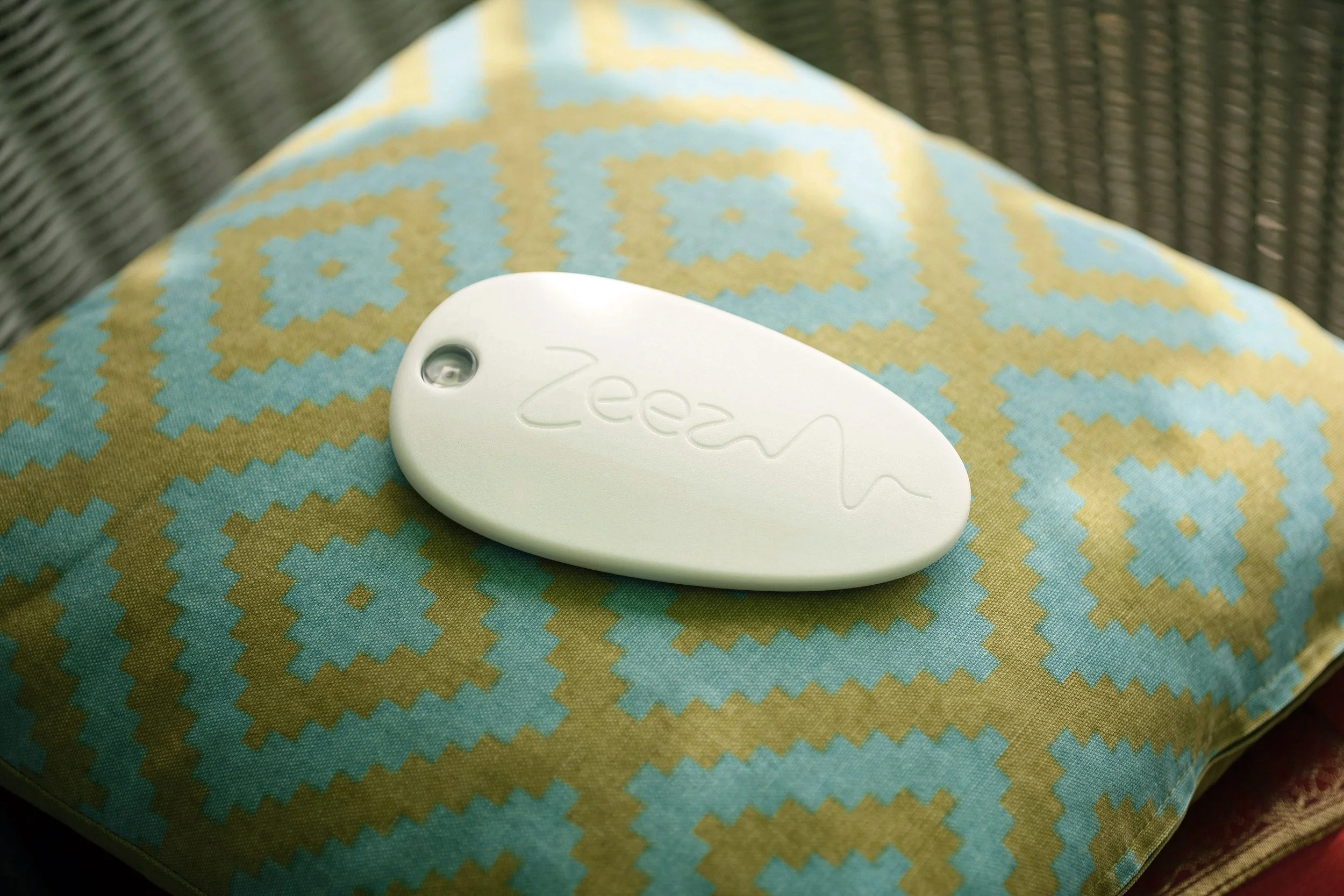
What came out of that is the Zeez Sleep Pebble - a small device that sits under the pillow and produces extremely low-power pulses, too gentle to cross the skull, designed to mirror the alpha, theta and delta brainwave patterns of a good sleeper as these change through the night. Whereas other devices use magnetic fields and electrical pulses to cross the skull and stimulate brain tissue to change its behaviour, the Zeez Sleep Pebble offers a changing pattern of tiny pulses generated under your pillow. There's nothing that crosses the skull. No stimulation. It is designed to prompt a resonant response. That can only happen if the signals emitted are precise, in frequency, waveform, pulse, and amplitude.
For the user, what makes the Zeez Sleep Pebble special is its simplicity. There is one button - no app, no headband, no subscription, nothing to configure. You press the button, slide the device under the pillow, and that's the entire instruction manual. That was one of my contributions. I knew that poor sleepers need simplicity. The Zeez Sleep Pebble is that rare sleep aid: something you can give to an exhausted person without handing them a job.
What happens when you give the Zeez as a gift
There's a nice story on our website from Jackie, who came across the Zeez Sleep Pebble when her husband saw it reviewed on The Gadget Show. She already had a Fitbit, an Apple Watch she never remembered to charge, and sleep sprays that did little. That Christmas he wrapped one up - no speech, just a hunch. Two months on, she was waking without the fog of exhaustion she'd carried for years: not an instant fix, but a shift she noticed and keeps noticing. An ordinary story - a husband took a chance on a small thing that made an extraordinary change to her life.
What to know before you give it
The Zeez Sleep Pebble doesn't change sleep overnight. When it helps, the change usually builds over one to three weeks. It works best in an electrically calm environment, so other electrical devices in the bedroom need to be switched off at night. That's the whole set-up. It comes with a 45-day trial and full refund if it doesn't suit the user, plus a two-year warranty - so you get weeks to decide with nothing at stake, and can take a chance without the fear of getting it wrong, as Jackie's husband did..
As for me now: hand me a Midnight Calm candle and my heart won't sink an inch.
Sources:
A Paravascular Pathway Facilitates CSF Flow Through the Brain Parenchyma and the Clearance of Interstitial Solutes, Including Amyloid β 2012 Iliff, Nedergaard
Sleep Drives Metabolite Clearance from the Adult Brain Xie, Nedergaard 2013
Brain clearance is reduced during sleep and anesthesia 2024, Wisden, Franks.
The glymphatic system clears amyloid beta and tau from brain to plasma in humans 2025, Iliff